

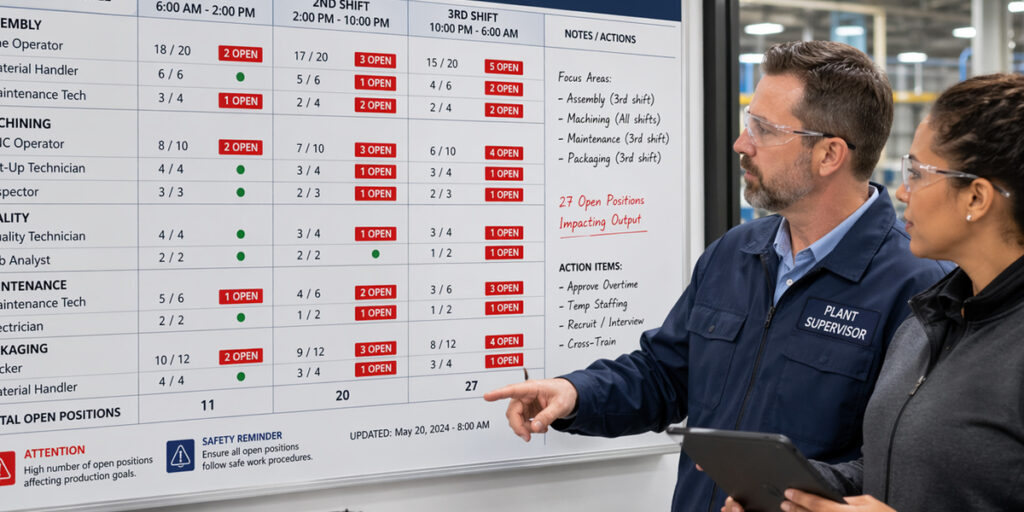
If your plant tracks OEE, downtime, scrap, and overtime like a hawk—but hiring gets measured by “we felt good about the candidate”—you’re basically running a precision operation with a roulette wheel in the front office. And in 2026’s manufacturing labor market, that’s… bold.
Here’s why: BLS data shows U.S. manufacturing employment at 12.591 million in March 2026 (up 15,000), with the average manufacturing workweek holding at 40.2 hours and 3.0 hours of overtime. Translation: plants are still producing, still stretching labor, and still living close to the edge.
Meanwhile, February 2026 JOLTS data shows manufacturing sitting on 439,000 job openings, with 286,000 hires and 295,000 separations. That gap isn’t just “HR being busy.” That’s churn and capacity risk.
So yes—speed matters. But speed without the right metrics just means you can make the wrong decision faster. (Congrats?)
The metrics that matter (and why your dashboard needs them)
1) Quality of hire: the only metric that wins twice
SHRM frames quality of hire around the real value a new hire delivers—performance, retention, and post-hire impact—not just whether they showed up for orientation.
Even more painful: SHRM benchmarking reports note only 20% of organizations track quality of hire. Which explains a lot.
For high-volume manufacturing, keep it practical:
- 90-day retention
- time-to-productivity / training completion
- attendance reliability
- safety incidents / near-miss patterns
- supervisor confidence by day 30/60/90
If you’re not measuring these, you’re optimizing for a hire… not for a workforce.
2) Funnel throughput: where “plenty of applicants” still turns into empty shifts
SmartRecruiters’ manufacturing benchmarks show manufacturers average 38 applicants per hire, yet still experience hiring friction—because the bottleneck is often flow, not volume. They also report 92% offer acceptance, which is great… if you can get to offer fast enough.
Watch these like a plant manager watches a constraint:
- time-to-review
- time-to-interview
- interview-to-offer rate
- candidate drop-off / ghost rate
- offer acceptance rate
When those numbers drift, it’s usually not “the market.” It’s process. (And process is fixable.)
3) Cost-per-hire is a control number. Value-per-hire is the strategy.
SHRM’s 2025 benchmarking pegs average nonexecutive cost-per-hire at $5,475. Useful—like knowing your utility bill is high. But not enough to improve the factory.
What leadership really needs is a “value-per-hire” mindset:
- Did this hire reduce overtime leakage?
- stabilize a shift?
- reduce rework by keeping skilled operators in seats?
- prevent safety incidents by improving training readiness?
That’s how recruiting earns a spot on the same scoreboard as production.
Where the data comes from (spoiler: you already have it)
Most manufacturers already have the raw ingredients:
- ATS data (stage timing, bottlenecks, source quality)
- recruiting analytics dashboards (vacancy fill rates, time to fill, source effectiveness)
- HRIS/turnover and attendance patterns
- shop-floor systems and training/safety records (to connect hiring to outcomes)
The win is stitching it into one loop—so hiring decisions get the same continuous improvement treatment as your lines.
Why this is an RPO problem (in a good way)
This is exactly where WSI TalentSync’s Recruitment Process Partnership model shines: building a repeatable, defensible hiring engine that prioritizes quality, retention, and fewer downstream surprises—not just “more applicants.”
Because a real partnership isn’t measured by resumes sent. It’s measured by whether your shifts stay staffed with people who stick and perform.
If you want a metrics-driven hiring engine (not a weekly fire drill with prettier spreadsheets), let’s talk. WSI TalentSync can help you set the right KPIs, clean up funnel bottlenecks, and connect hiring outcomes to real plant performance—through modular RPO support or full partnership coverage.


